
Why retail shipping rates cost you 40-60% more
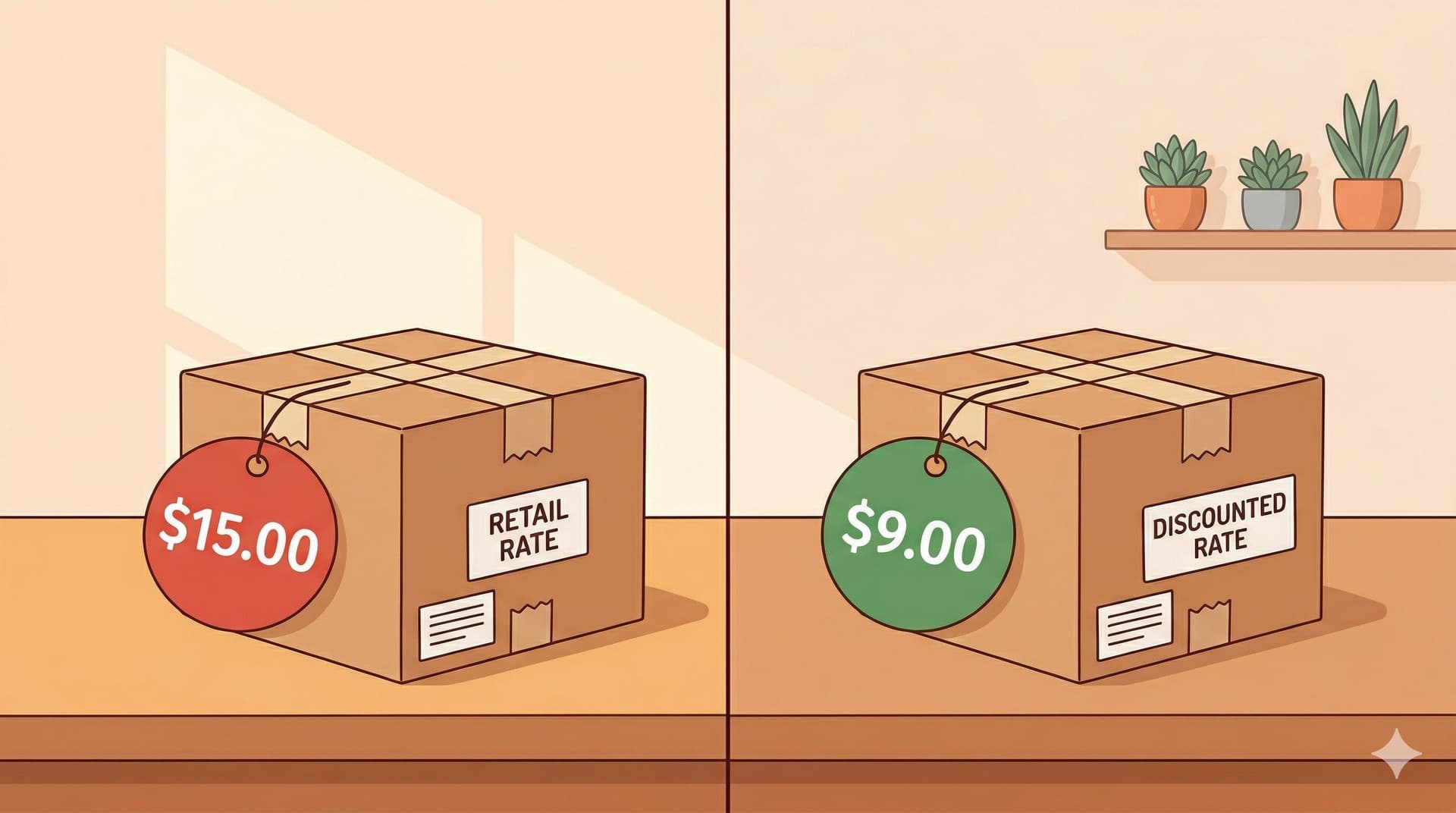
If you walk into a post office or go to usps.com and buy a label, you're paying the full published rate. Same with UPS and FedEx. Their website prices are the sticker price that nobody with serious volume actually pays.
Big retailers ship millions of packages a year, so they negotiate directly with carriers for steep discounts. A Priority Mail label that costs you $9.50 might cost them $5.20. That's not a rounding error. It's the difference between a profitable order and one that barely breaks even.
The problem is that carriers don't advertise these discounts to small shippers. There's no "apply for lower rates" button. You either ship enough to get a sales rep's attention, or you pay retail.
Hidden ecommerce shipping costs eating into your margins
Retail rates aren't the only place you're losing money. Most small businesses also deal with:
Surcharges you didn't expect. Residential delivery surcharges, fuel surcharges, dimension-based pricing adjustments. These show up after you've already quoted a shipping price to your customer.
Manual rate shopping. If you're opening three browser tabs to compare USPS, UPS, and FedEx for every order, that's 5-10 minutes per shipment. At 20 orders a day, you're spending over an hour just picking carriers.
Address correction fees. Ship to a bad address and the carrier charges you $15-20 to fix it, or returns the package entirely. Without address validation, this happens more often than you'd think.
All of these eat into your margins quietly, order by order.
How shipping platforms get you lower rates
Shipping platforms like NinjaShip give you access to pre-negotiated commercial rates from major carriers. Instead of each business trying to hit volume thresholds alone, you get the same discounted shipping labels as everyone on the platform combined.
This is the same model that Stamps.com pioneered years ago, but modern platforms do it better. You get real-time rate comparison across carriers, address validation built in, and no monthly fees or volume commitments holding you hostage.
The discounts are real. On lightweight First Class packages, you can save up to 89% off retail USPS rates. Priority Mail typically runs 20-50% less than the post office price. UPS, FedEx, and DHL discounts vary by service but the savings are consistent. A package that costs $12.80 at the post office counter might be $4.50 through a platform with USPS Commercial Pricing.
What to look for in a shipping platform
Not all platforms are equal. Some lock discounts behind monthly plans or require minimum volumes. Others mark up the carrier rate and call it "discounted." Here's what actually matters:
Transparent pricing. You should see the exact carrier rate with no markup or hidden platform fees. If a platform won't show you the base rate, they're making money on the spread.
Multi-carrier comparison. The cheapest option changes depending on package size, weight, destination, and speed. A good platform shows you USPS, UPS, FedEx, and DHL side by side so you pick the best rate every time.
No monthly minimums. If you ship 10 packages a month, you shouldn't be paying $25/month for the privilege. Pay-per-label pricing means you only pay when you actually ship.
Store integrations. If you sell on Shopify, WooCommerce, BigCommerce, or other platforms, your orders should flow in automatically. Copy-pasting addresses is how mistakes happen.

How much can you save? A 100-package example
Let's say you ship 100 packages a month, averaging 2 lbs each, going Priority Mail to residential addresses across the US.
At USPS retail rates, you're looking at roughly $9.50 per package, or $950/month.
With discounted commercial rates through a shipping platform, that same label might average $5.50, or $550/month.
That's $400 saved per month, or $4,800 per year. For a small business, that could be your marketing budget, a new hire's hours, or just money back in your pocket.
And that's just one carrier. If you're also shipping some orders via UPS Ground (which is often cheaper for heavier packages), the savings stack further.
Start saving on your shipping costs today
You don't need to ship thousands of packages to access better rates. Platforms like NinjaShip give every merchant the same discounted rates, whether you're shipping 5 orders a week or 500 a day. No monthly fees, no commitments.
Sign up, connect your store, and compare rates on your next shipment. Most people see savings on their very first label.